The Moon is about to get a new crater — and this one will be made by us.
A spent upper stage from a SpaceX Falcon 9 rocket is predicted to slam into the lunar surface on August 5, 2026, at about 5,400 miles per hour. That sounds dramatic, and in one sense it is. Let’s be clear though, our nearest celestial neighbor has been taking cosmic hits for billions of years. Every bright crater you see through binoculars or a backyard telescope is a reminder that the Moon is a world shaped by impacts.
This time, though, the impactor is not an asteroid or comet fragment. It is human-made hardware.
The object is catalogued as 2025-010D, the discarded upper stage from the Falcon 9 rocket that launched Firefly Aerospace’s Blue Ghost Mission 1 on January 15, 2025. Blue Ghost went on to make a historic commercial lunar landing in Mare Crisium on March 2, 2025, successfully operating NASA science instruments on the Moon.
After doing its job, the Falcon 9 upper stage did not simply vanish. It remained in a wide, looping orbit through the Earth-Moon system. According to astronomer Bill Gray of Project Pluto, who tracks high-orbiting space objects, the stage has been observed more than a thousand times, allowing its future path to be calculated with increasing precision.
As of Gray’s latest published calculation, the impact is expected at about 06:44 UTC on August 5, 2026 — that is 2:44 a.m. Eastern Daylight Time. The predicted crash site lies near the lunar crater Einstein, close to the Moon’s western limb as seen from Earth, on the sunlit near side of the Moon.
Update — August 3, 2026: Could Backyard Telescopes See the Moon Impact?
When I first wrote about this upcoming lunar crash a few months ago, the safest answer was: don’t expect to see much from Earth. That is still good advice for casual skywatchers — but there is now a more interesting possibility for experienced observers with larger backyard telescopes and imaging gear.
The latest tracking by astronomer Bill Gray of Project Pluto now places the impact at about 06:35:37 UTC on August 5, 2026, or 2:35 a.m. EDT. The Falcon 9 upper stage is expected to hit near the crater Einstein, very close to the Moon’s western limb as seen from Earth. That limb location matters because any dust and rock blasted upward may briefly rise above the bright lunar edge and appear against the blackness of space.
The impact flash itself will probably be very difficult to see. Unlike fast-moving meteoroids that strike the Moon at much higher speeds, this rocket stage is expected to hit at about 2.43 km/s, which is relatively slow in impact terms. That means less of the impact energy may be converted into a bright visible flash. But the ejecta plume — the spray of lunar dust and rock thrown up from the new crater — is now the real thing to watch for.
New modelling suggests the plume could be more promising than the flash. A recent simulation led by William Jo at the University of Texas at Austin predicts that the impact may produce an ejecta curtain reaching roughly 15 to 20 km high, with a central spike possibly rising 75 to 100 km above the lunar surface. Space.com reports that this plume could be bright enough for a few minutes to be detected by sufficiently sensitive telescopes, although the researchers caution that the real event may look different from the model.
So, can backyard skywatchers see it? Maybe — but this is not a naked-eye event, and it is not likely to be easy visually through a small telescope. The Weather Network, citing Gray’s observing advice, suggests that a serious attempt would likely require a 150–200 mm telescope — roughly a 6- to 8-inch scope — at about 150x to 250x magnification, ideally with a camera recording the lunar limb before, during, and for several minutes after impact.
The best strategy is not just to stare at the Moon at the exact second of impact. If anything appears, it may be the dust plume rising after the crash. Gray recommends imaging before the predicted impact time and continuing for at least a few minutes afterward, because some faster-moving ejecta may take time to climb high enough above the lunar limb to become visible.
For skywatchers in eastern North America, including much of eastern Canada and the eastern United States, the timing is at least favourable: it will be nighttime, and the Moon should be above the horizon. But this is still a challenging observation. Atmospheric steadiness, telescope size, camera sensitivity, the exact impact location, and the brightness of the sunlit lunar surface will all matter.
The bottom line: most people will not see anything obvious, but advanced amateurs and observatories may have a real chance of recording a short-lived dust plume. And scientifically, that makes this accidental crash much more interesting than it first appeared. Researchers are hoping the event can help test models of how human-made objects impact the Moon — useful information as more spacecraft, landers, and eventually astronauts head into the lunar environment.
This is also a reminder that the Moon is not just a pretty light in our sky. It is a real world — one we are beginning to visit more often — and even our leftover hardware is now becoming part of its changing landscape.
Will we see it from Earth? Probably not.
That may be the most disappointing part for skywatchers. The Moon will be a little more than half illuminated at the time, and the impact zone will be near the bright edge of the lunar disk. Even a high-speed crash may be overwhelmed by the glare of the sunlit lunar surface. Specialized observatories may try to catch the flash, but this is not likely to be a backyard telescope spectacle.
Still, the impact could be scientifically useful. When the rocket stage hits, it should blast out a fresh crater and expose subsurface lunar material. NASA has done something similar on purpose before: in 2009, the LCROSS mission deliberately crashed a Centaur rocket stage into the Moon’s south polar region to study material kicked up from a shadowed crater. That mission helped strengthen evidence for water ice and other useful materials in permanently shadowed lunar soil.
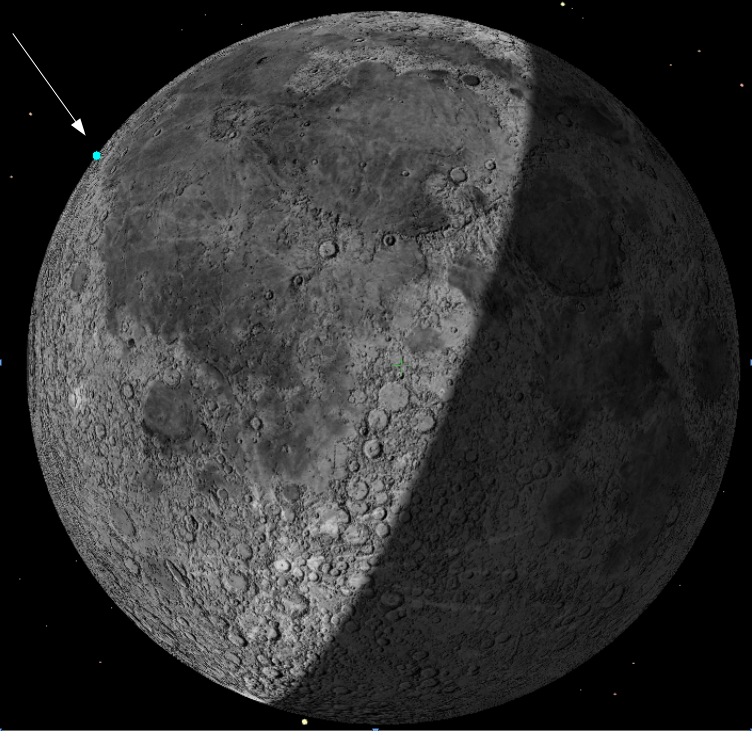
This new impact is not a planned science experiment in the same way. But if NASA’s Lunar Reconnaissance Orbiter can image the site afterward, scientists may get a valuable before-and-after look at a fresh human-made scar on the Moon. In 2022, NASA’s Lunar Reconnaissance Orbiter spotted another rocket-body impact site near Hertzsprung crater; that crash created a strange double crater roughly 28 meters wide.
So should we worry?
For this particular event, not really. The Moon is vast, and the predicted impact site is not near active lunar hardware. But the bigger story is worth paying attention to. We are entering a new era of lunar activity. Commercial landers, government missions, orbiters, relay satellites, and eventually astronauts are all part of the growing traffic between Earth and the Moon.
That means the space around the Moon — what scientists call cislunar space — is becoming busier.
And just like roads, shipping lanes, and airspace here on Earth, the Earth-Moon environment will need better traffic rules. Rocket stages, spent spacecraft, and mission leftovers do not disappear just because their main job is finished. Some burn up in Earth’s atmosphere. Some drift into solar orbit. Some remain in strange gravitational loops. And occasionally, as we’re seeing now, one ends up on a path to the Moon.
There is also a poetic side to all this.
The same launch that sent Blue Ghost on its successful journey to the Moon also left behind a piece of machinery that will now become part of the lunar landscape. A mission of exploration will end with a new crater — a tiny mark compared with the great basins and scars made by ancient cosmic collisions, but still a mark made by human hands.

The Moon has always been a mirror for us. It reflects sunlight, yes, but it also reflects our ambitions, our curiosity, and sometimes our messiness. We are learning how to live and work beyond Earth, and that includes learning how to be better caretakers of the space environment.
So on August 5, somewhere near the crater Einstein, a silent impact will flash across the lunar surface. No sound. No atmosphere. No shockwave rolling across the airless plains. Just a sudden burst of energy, a spray of dust and rock, and one more small crater added to the Moon’s ancient face.
It is a reminder that the Moon is not just a distant light in our sky. It is a real place — a rugged, cratered world only three days away by spacecraft — and humanity is slowly becoming part of its story.

Sign Up for my FREE monthly newsletter

